Navigating Business Acquisition Due Diligence: A Seller’s Guide
- Carson Bomar - Business Broker

- Aug 13
- 18 min read
When a buyer utters the words “due diligence,” a lot of business owners tense up. We’ve seen it countless times. But let’s reframe this: business acquisition due diligence is simply the buyer's homework. They’re doing their part to confirm the value you've poured your life into building. It’s no different than a home inspection before you close on a house; any serious buyer is going to want to look under the hood.
What Due Diligence Really Means for You as a Seller

It's time to stop seeing this stage of the sale as an interrogation. Instead, think of due diligence as your opportunity to prove your company’s worth, build trust with the buyer, and confidently justify your valuation. A well-prepared owner can turn what often feels like a source of anxiety into a moment of strength.
This is a completely normal and necessary step in any serious business sale. We’ve guided countless owners through it, and a clear pattern emerges. Those who are organized and transparent tend to breeze through this phase. Others see promising deals hit a wall over surprises that were entirely preventable. This is particularly frustrating for owners who've tried to sell before and had deals fall apart at this very stage.
Why Preparation Is Your Best Strategy
The goal is simple: get ahead of any surprises. A buyer is just verifying the story you’ve already told them through your financials, operations, and legal documents. When they can easily check every box and confirm your claims, their confidence in the deal soars, and the momentum toward closing builds.
On the other hand, disorganized records or unexpected liabilities create friction and plant seeds of doubt. This is where good deals get rocky. Buyers start asking themselves, "What else don't I know?" That's a question you never want a buyer to ask. Being prepared means you stay in control of the narrative, protecting your value and your peace of mind.
This verification process has become even more critical as the M&A market has evolved. With deal values climbing, buyers are protecting their investments with more meticulous reviews. In 2022, for example, the global M&A market was on track to blow past $4.1 trillion, which shows just how high the stakes are. This level of activity means a thorough, clean due diligence process is more important than ever for getting a deal done right.
Key Takeaway: Due diligence isn't about finding flaws to kill a deal; it's about confirming value to close a deal. Your preparation and transparency are the most powerful tools you have to ensure a smooth process.
This guide will walk you through getting your house in order so you can handle the buyer’s questions with poise and get the peace of mind you deserve. For a broader look at the entire sales journey, you can check out our comprehensive guide to selling your business.
The Four Key Areas Buyers Investigate
When a buyer kicks off the business acquisition due diligence process, it can feel like they’re asking for every document you’ve ever created. It’s an intense period, but it’s not a random fishing expedition. Buyers are laser-focused on four core areas.
Knowing these pillars helps you get organized and feel more in control. It turns what could be an overwhelming wave of requests into a manageable checklist. Think of it this way: the buyer is simply trying to confirm that your business is financially sound, legally clean, operationally stable, and has a healthy customer base.
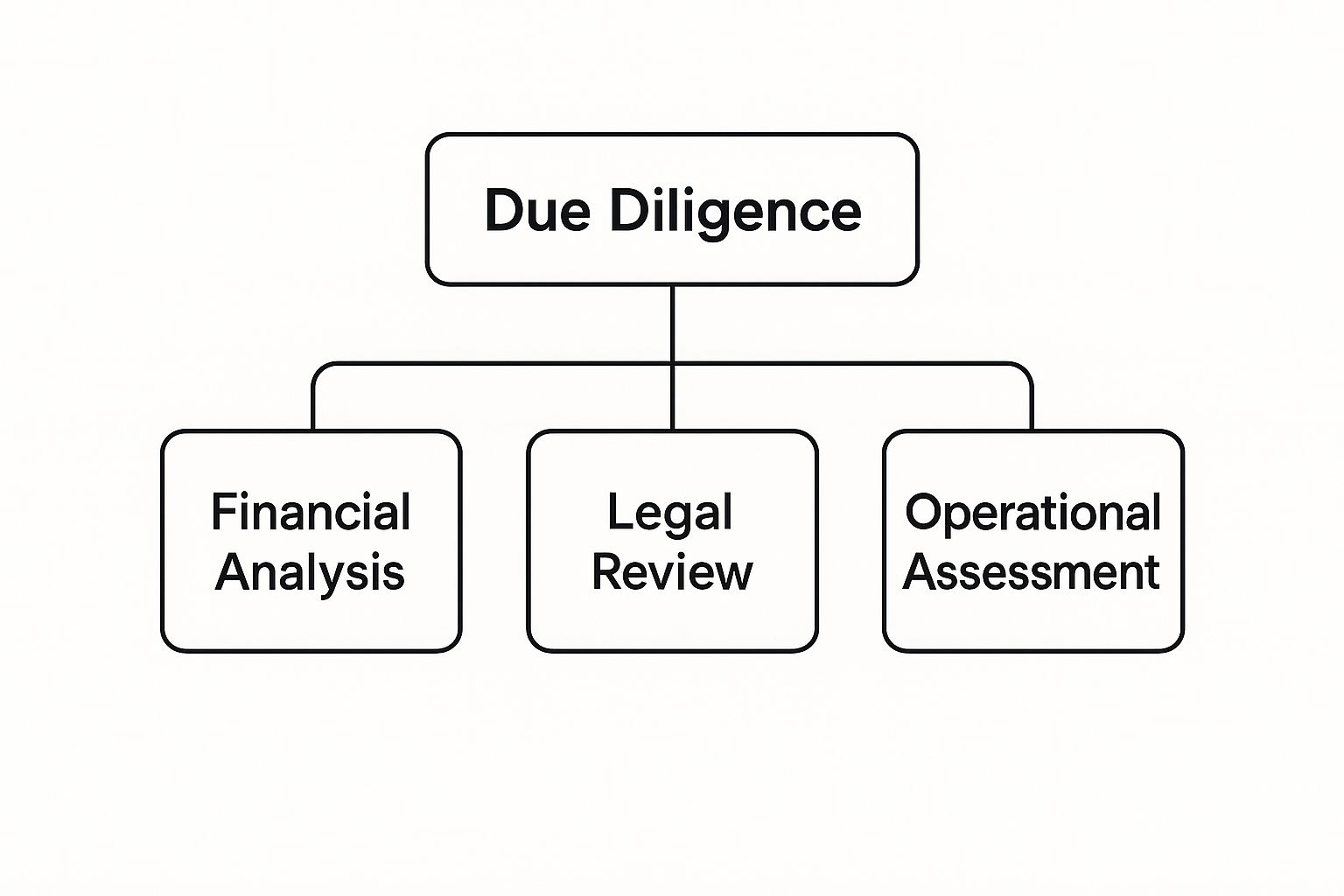
Breaking it down like this helps you prepare for what’s coming and gives you a clear road map for gathering your documents, maximizing your value and minimizing risk.
Financial Diligence
This is where your numbers go under the microscope. The buyer’s main goal here is to prove that the financial story you’ve told them is accurate and, most importantly, sustainable. They need to be absolutely certain the profitability they're paying for is real and repeatable.
We’ve seen a lot of deals get bogged down right here. If your books are messy or you can’t back up your adjustments with hard proof, it immediately plants seeds of doubt.
Get ready for requests for:
Historical Financials: At least three to five years of your profit and loss (P&L) statements, balance sheets, and cash flow statements.
Tax Returns: Corporate tax returns for that same period, which they’ll use to cross-reference against your P&Ls.
Bank Statements: To verify revenues and major expenses.
Accounts Receivable and Payable Aging: This helps them understand your cash flow cycle and spot any potential collection problems.
A buyer isn't just looking backward; they're trying to build a reliable forecast for the future. Clean, verifiable financials give them the confidence to pay top dollar for your company’s future earnings.
Legal Diligence
The mission for legal due diligence is simple: uncover any hidden liabilities. A buyer needs to know they aren't about to inherit a messy lawsuit, a compliance nightmare, or some other legal landmine that could blow up after the deal closes. This is all about risk mitigation for them.
This is where having a transaction attorney who specializes in M&A becomes absolutely critical. They'll review every contract and corporate document to make sure there are no skeletons in the closet.
Key documents they’ll want to see include:
Corporate Records: Your articles of incorporation, bylaws, meeting minutes, and any shareholder agreements.
Contracts: Every significant agreement with customers and suppliers, as well as property leases and employee contracts.
Permits and Licenses: Proof that your business is operating in full compliance with all relevant U.S. federal, state, and local regulations.
Litigation History: A clear summary of any past, present, or even threatened legal disputes.
Operational Diligence
Here, the buyer is trying to answer one crucial question: "Can this business run smoothly without the current owner?" They need to get a feel for how your company really operates day-to-day, especially if they are a private equity buyer who isn't an expert in your specific industry.
They're sizing up the systems, processes, and people that make your business tick. If all the crucial knowledge is stuck in your head, that’s a huge risk for them.
Be prepared to provide documentation and have deep conversations about:
Key Employees: Who are the critical team members, what are their roles, and are they likely to stick around after the sale? This is a key concern, as a buyer wants to ensure a smooth transition with minimal disruption.
Standard Operating Procedures (SOPs): Do you have written guides for core functions like marketing, sales, and order fulfillment?
Technology and Assets: An inventory of the essential software, equipment, and other physical assets needed to run the business.
Supplier Relationships: Details on your key vendors and the stability of your supply chain.
Customer Diligence
Finally, the buyer will put your revenue streams under scrutiny. They want to gauge the health and stability of your customer base to feel confident that sales won't dry up the day they take over.
One of the biggest red flags you can wave is customer concentration, where one or two clients make up a huge chunk of your revenue. If that one client leaves, the business could crumble.
Expect questions that dig into:
What is your customer churn rate?
How diverse is your customer base? No single customer making up more than 15% of revenue is a great benchmark.
What is the average lifetime value (LTV) of a customer?
Proactively gathering this information isn't just about getting ready for due diligence; it helps you truly understand what drives the value of your company. This whole process is deeply tied to how a business is priced, and knowing these details inside and out gives you a much stronger hand during negotiations. If you want to go deeper, you can learn more about how to value a business for a successful sale in our detailed guide.
Key Focus Areas in Due Diligence
Diligence Area | Buyer's Core Question | Example Documents Requested |
|---|---|---|
Financial | "Are the profits real and sustainable?" | P&L Statements, Tax Returns, Bank Statements |
Legal | "Are there any hidden liabilities or risks?" | Corporate Records, Key Contracts, Permits/Licenses |
Operational | "Can the business run without the owner?" | Org Charts, SOPs, Asset Lists |
Customer | "Is the revenue stream stable and diverse?" | Customer List, Churn Rate Data, Sales Reports |
Thinking about due diligence through this structured lens: Financial, Legal, Operational, and Customer, helps demystify the process and allows you to prepare methodically, ensuring you're ready to answer any question that comes your way.
Understanding the Modern Due diligence Timeline

If you’ve ever tried to sell your business, you might have felt the frustrating drag of the business acquisition due diligence process. It’s a huge point of friction, and frankly, a story we hear all the time from owners who come to us after a deal fell apart with another firm. They feel like the process just went on and on, slowly killing the momentum and their patience.
Here’s the thing: the market has changed. The days of a quick, 45-day diligence period are mostly gone. Today’s serious buyers, the ones willing to pay top dollar for a great business, are taking their time. We’re now seeing a 60 to 90-day timeline become the standard as they perform a much deeper, more strategic review.
A Shift from Checklist to Conviction
Don’t mistake this longer timeline for a buyer who’s getting cold feet. In reality, it’s usually the opposite. When a buyer commits to a 90-day diligence period, they’re signaling that they’re serious about making a smart investment. They're not just ticking boxes; they're investing significant time and money (often tens or hundreds of thousands of dollars) to build genuine conviction around the deal.
This shift is a direct result of a more competitive M&A environment. With sellers rightly demanding higher valuations, buyers have to dig deeper to justify paying that premium price. They’re bringing in more outside experts, from financial auditors to operational consultants, to make sure the value is really there. This more intense approach is now the norm, a trend you can discover more about on TKO Miller's blog.
For a serious buyer, a longer diligence timeline isn't about looking for reasons to walk away; it's about building the confidence needed to run toward the finish line.
How to Use This Knowledge to Your Advantage
Knowing this new reality is a huge advantage. Instead of getting frustrated by a 75-day timeline, you can see it for what it is, a sign of a committed buyer, and prepare accordingly. This mindset shift can completely change the dynamic of your deal and give you back a sense of control.
As the seller, your job is to make the process as smooth and efficient as possible. Here’s how you can turn a longer diligence period into one of your strengths:
Be Exceptionally Prepared: Get your data room completely organized and all your documents ready before you even sign a Letter of Intent (LOI). The better prepared you are, the more you control the pace.
Be Hyper-Responsive: When the buyer's team asks for something, get it to them quickly and completely. Being prompt builds incredible goodwill and keeps the deal moving forward.
Communicate Proactively: Work closely with your M&A advisor to maintain an open line of communication. Understanding the "why" behind a request can head off many potential misunderstandings.
By anticipating a longer, more detailed business acquisition due diligence process, you show the kind of professionalism that sophisticated U.S. buyers, like private equity firms, appreciate. You're not just selling a business; you're managing a professional transaction, building trust, and keeping your deal on a solid path to a successful close.
Common Red Flags That Can Derail Your Deal
When a buyer puts your business under the microscope during due diligence, they are actively stress-testing every assumption to make sure the value is real and, more importantly, sustainable after you’re gone.
Every business has a few quirks, and that’s okay. But some issues are more than just minor imperfections; they're deal-breakers. These "red flags" can stop a deal dead in its tracks, force a painful price reduction, or at the very least, create tremendous friction and doubt.
Think of this as a pre-sale inspection for your business. Getting ahead of these common problems before you go to market is one of the most effective things you can do to protect its value and ensure a smooth closing. Let’s dive into the issues we see tank deals most often, and how you can fix them.
Over-Reliance on a Few Customers
This is probably the biggest and most frequent red flag we encounter. If a potential buyer sees that a huge chunk of your revenue comes from just one or two clients, alarm bells will go off. Their immediate thought is, "What happens if that one big customer leaves the day after I buy the company?" Just like that, the business's perceived value could be cut in half.
Why it’s a problem for buyers: High customer concentration signals a massive, undiversified risk to future cash flow. It makes your revenue streams look fragile and the entire operation feel unstable.
How to fix it:
Diversify Your Client Base: Start an active campaign to bring in new customers to reduce the percentage of revenue tied to any single client. A healthy benchmark to aim for is having no single customer account for more than 10-15% of your total revenue.
Strengthen Key Relationships: If you can't diversify quickly, lock in what you have. Get your largest clients on solid, long-term contracts. This gives a buyer peace of mind that the revenue won't just walk out the door.
Deepen the Connections: Make sure the relationship with a key client isn't just with you. Introduce other key members of your team, like an operations manager or head of sales. The goal is to make the client loyal to the company, not just the owner.
Undocumented Processes and Owner Dependency
Many incredible businesses are built by entrepreneurs where all the critical knowledge, the "secret sauce" lives inside their head. That’s great when you’re running the show, but for a buyer, it’s a nightmare. They need to be confident the business can run, grow, and thrive without you calling the shots from day one.
We once worked with a fantastic manufacturing business owner whose deal nearly fell apart because his entire production schedule was managed on a single, color-coded whiteboard that only he understood. The buyer couldn’t see a path to a smooth transition, creating significant friction.
Why it’s a problem for buyers: If the knowledge can't be transferred, there's no scalable, repeatable system to buy. This makes the acquisition incredibly risky. The buyer rightly fears that the core value of the business will walk out the door the day you do.
How to fix it: Start documenting everything now. Create simple Standard Operating Procedures (SOPs) for all the key functions: how you generate leads, how you close sales, how you fulfill orders, how you handle customer issues. This isn't just for the sale; it makes your business more efficient and valuable today.
Messy or Unverifiable Financials
A buyer has to trust your numbers, period. If your financial records are a jumbled mess, you mix personal and business expenses, or your P&L doesn't easily tie back to your tax returns and bank statements, you’re planting seeds of doubt. Buyers simply don't pay top dollar for a business whose profitability they can't prove.
Why it’s a problem for buyers: Sloppy financials make it impossible for them to confirm your past performance or build a reliable forecast for the future. It signals a lack of professionalism and makes them wonder, "If the books are this messy, what else are they hiding?"
How to fix it: Get with your accountant or CPA immediately and start a cleanup project. Unwind all personal expenses from the business accounts, make sure your Profit & Loss statements are crystal clear, and be prepared to explain any unusual line items. This simple housekeeping can add tremendous credibility and value.
Unresolved Legal or Team-Related Issues
Nothing sends a buyer running for the hills faster than the threat of an unforeseen lawsuit or a key employee jumping ship right after closing. Any lingering legal disputes, compliance gaps, or critical team members who aren't under contract are major red flags that scream "risk."
Why it’s a problem for buyers: They are buying your assets, not your liabilities. An unresolved legal problem represents an unknown and potentially massive future cost. Similarly, the departure of a key programmer or your top salesperson could cripple the business.
How to fix it:
Resolve Disputes: Work with your attorney to settle any outstanding legal issues before you go to market. Don't let your problems become the buyer's problems.
Secure Your Team: Put employment agreements and sensible non-compete clauses in place for your most essential people. This shows a buyer that the team is stable and committed, which is a huge part of maintaining the business's value post-sale.
Conduct a Self-Audit: Do your own mini-due diligence. Review all your contracts, permits, and licenses to make sure you're in full compliance. It's far better for you to find and fix an issue than for the buyer to discover it.
Assembling Your Expert Deal Team

Selling your business will likely be the single most significant financial transaction of your life. Let that sink in. This is absolutely not a DIY project.
Trying to navigate the complexities of business acquisition due diligence and the entire sale process on your own is like trying to quarterback an NFL team without an offensive line. You’re left exposed, vulnerable, and almost certain to get sacked.
This isn’t a job for your generalist family lawyer or the CPA who handles your annual taxes. You need an A-Team of specialists who live and breathe M&A deals every single day. When owners come to us after a frustrating, failed sale attempt with another firm, we almost always find the same missing piece: a specialized and fully aligned advisory team.
Your Three Key Players
To truly protect your interests, maximize your company's value, and give yourself priceless peace of mind, you need three critical advisors in your corner. Each plays a distinct and vital role.
The M&A Advisor (Your Quarterback): Think of us as your strategic guide for the entire game. An M&A advisor, like Carson Bomar & Matt Perkins at Exit Game Plan, manages the entire sale from start to finish. We find and vet the right buyers, create the marketing materials, manage the flow of information during due diligence, and spearhead negotiations to get you the absolute best terms. We become your single point of contact, shielding you from the daily grind so you can focus on what you do best—running your business.
The Transaction Attorney (Your Defense): This lawyer’s world revolves around one thing: M&A. They are experts at drafting and scrutinizing every legal document, from the initial Non-Disclosure Agreement (NDA) all the way to the complex final purchase agreement. Their sole mission is to protect you from hidden risks and future liabilities that could haunt you long after the deal is done. A great transaction attorney ensures the legal foundation of your sale is rock-solid.
The Transaction CPA (Your Financial Guardian): This role goes far beyond basic accounting; it’s about defending the financial integrity of your business under a microscope. A CPA who specializes in transactions helps prepare your financials for the intense scrutiny of due diligence, validates the crucial adjustments to your earnings (known as add-backs), and provides critical advice on the U.S. tax implications of different deal structures. Their work ensures the buyer’s finance team sees a clear, credible, and defensible picture of your company’s real profitability.
Investing in this expert team isn’t a cost; it’s one of the highest-ROI decisions you can make. Their expertise directly translates into a higher sale price, better terms, and a dramatically lower risk of the deal falling apart.
For business owners who have been through a frustrating, unsuccessful sale before, the reason often comes back to a misaligned strategy or a team that simply wasn't specialized enough. At Exit Game Plan, our approach is different. We take the time upfront to align on a go-to-market strategy that matches your goals. If we can’t agree on a realistic plan, we’d rather part ways than set you up for disappointment. This ensures that when we do go to market, everyone is on the same page and positioned for success.
Your Path to a Smooth and Successful Closing
The journey from putting your business on the market to finally sitting at the closing table is a marathon. After the intense examination of business acquisition due diligence, you can finally see the finish line. Crossing it with confidence comes down to a few key principles we've discussed: think of due diligence as a confirmation, not a confrontation; understand that solid preparation is your greatest strength; and know that bringing the right team of experts on board is non-negotiable.
Turning the Hurdle into a Confirmation
We get it, this whole process can feel intimidating. This is particularly true for owners who have tried selling before, only to be left frustrated when a deal falls apart because of misaligned expectations or preventable surprises.
At Exit Game Plan, our entire philosophy is built to sidestep those exact problems.
We focus on getting everyone aligned from the very beginning. By agreeing on a realistic, transparent strategy upfront, we ensure that when we introduce your business to buyers, everyone is operating from the same playbook. This deep preparation flips the script on diligence, changing it from a stressful hurdle into what it’s supposed to be: a final confirmation of the incredible value you've built.
This proactive mindset is more important than ever. In 2024, global M&A activity jumped by about 16% to roughly $3.1 trillion, a clear signal that buyer confidence is back. This competitive environment means buyers are digging deeper than ever to justify strong valuations, which makes seller preparedness the single most critical factor for success. You can read more about the value of financial due diligence in today’s market.
By the time you reach the closing table, there should be no surprises. A smooth final phase is the direct result of the hard work and strategic planning done months earlier.
Your job is to make the buyer's final "yes" an easy one. When they look under the hood and see a well-organized company with clean books and a professional advisory team, their confidence soars. This paves the way for a smooth close and transition. The Letter of Intent marks a huge step in this journey, and you can explore more about it in a seller's guide to the letter of intent to purchase.
Ready to Plan Your Exit the Right Way?
If you're thinking about selling your business in the next 1-3 years, whether it's your first time or you’ve been down this road before, let's connect. We can help you build a game plan that’s tailored to your personal goals, maximizes your company's value, and prepares you for a successful closing. Our initial conversations are always confidential and without pressure.
Common Questions We Hear About Due Diligence
Even with a good roadmap, the journey through business acquisition due diligence can feel winding. It’s natural to have questions, especially when it’s your business under the microscope. We get it. Here are some of the most common questions we hear from owners just like you, with straightforward answers from our experience in the trenches.
How Much Does Due Diligence Cost Me as the Seller?
This is a great question. While the buyer pays for their own team, their lawyers, accountants, and consultants, you as the seller will also have your own expert deal team. This typically includes your M&A advisor, a transaction attorney, and a CPA.
It’s tempting to see this as a "cost," but we encourage you to view it as an essential investment. A top-notch team is your best defense, protecting the legacy you’ve built and ultimately maximizing your final take-home price. They often save you multiples of their fees by steering you away from costly mistakes, negotiating better terms, and keeping the whole process on track. We're always transparent about costs upfront, so you’ll never face any surprises.
How Do I Keep the Sale Confidential During This Process?
Keeping a potential sale under wraps is absolutely critical, and it's one of our highest priorities. We manage this with a disciplined, multi-layered approach to protect your privacy and prevent disruption to your team and customers.
Ironclad Agreements: Before any sensitive information is shared, a potential buyer is thoroughly vetted and must sign a legally binding Non-Disclosure Agreement (NDA). No signature, no data. It’s that simple.
Staged Information Release: We never just hand over the keys to the kingdom. Information is shared in controlled stages. We start with high-level, anonymized data. Highly sensitive details, like customer lists or employee files, are held back until the very final stages, once a buyer is firmly committed.
A Secure Gatekeeper: Your M&A advisor manages the entire flow of information through a secure virtual data room. This system gives us complete control over who sees what and when, protecting your business operations.
What Happens if a Buyer Finds an Issue?
First, don't panic. It’s incredibly common for buyers to uncover something unexpected. No business is perfect. A discovery during diligence is usually the start of a conversation, not the end of the deal.
When an issue comes up, the buyer might propose a price adjustment (often called a "re-trade"), ask you to fix the problem before closing, or request a specific indemnity to shield them from any future risk related to that one item.
This is where an experienced M&A advisor truly earns their keep. We can help you calmly analyze the request, negotiate a fair and reasonable solution, and keep a small bump in the road from derailing the entire deal.
The best strategy is a good offense. That’s why we work with you to identify and address any potential red flags before your business ever goes on the market.
Can a Buyer Back Out After Signing a Letter of Intent?
Yes, they can. It's vital to understand that a Letter of Intent (LOI) is almost always non-binding, except for a few specific clauses like confidentiality and exclusivity (meaning you can’t shop the deal to others for a set period).
An LOI is a sign of serious intent, but the deal hinges on the buyer successfully completing due diligence to their own satisfaction. If they uncover something that fundamentally changes their view of the company's value or risk profile, they can walk away. This reality highlights just how important it is to have your house in order before you sign an LOI. A thorough, upfront, and transparent process is the best way to ensure your deal makes it all the way to the closing table.
Wrapping It Up: Turning Due Diligence into Your Advantage
Selling your business is never just about finding a buyer, it’s about giving them the conviction to close. Due diligence isn’t a trap designed to trip you up; it’s the buyer’s final opportunity to confirm that your business is every bit as valuable as you’ve presented it to be.
When you approach this stage with clean records, documented processes, a stable team, and an experienced M&A deal team in your corner, you shift the dynamic entirely. You’re no longer reacting to a buyer’s requests—you’re leading them through a clear, transparent process that builds trust and protects your value.
The truth is, well-prepared sellers rarely lose deals in due diligence. They enter the process knowing what questions will be asked, have the answers ready, and keep control of the narrative from start to finish. That’s how you turn what many see as the most stressful part of a sale into the final proof point that seals the deal.
If you’re thinking about selling in the next one to three years, now is the time to start preparing. The earlier you begin, the more leverage you’ll have when serious buyers come to the table. At Exit Game Plan, we help owners anticipate every step, eliminate surprises, and position their businesses for a smooth, top-value sale.
Navigating the sale of your business is a complex journey, but you don’t have to do it alone. If you're ready to create a clear strategy for your exit, our team at Exit Game Plan is here to help. Contact us today for a no-pressure consultation or a confidential valuation.


Comments